DialoguesIII · Plato
Brilliant on demo, broke with real money. Whose cave are you in?
Demo versus real money · the hot–cold empathy gap
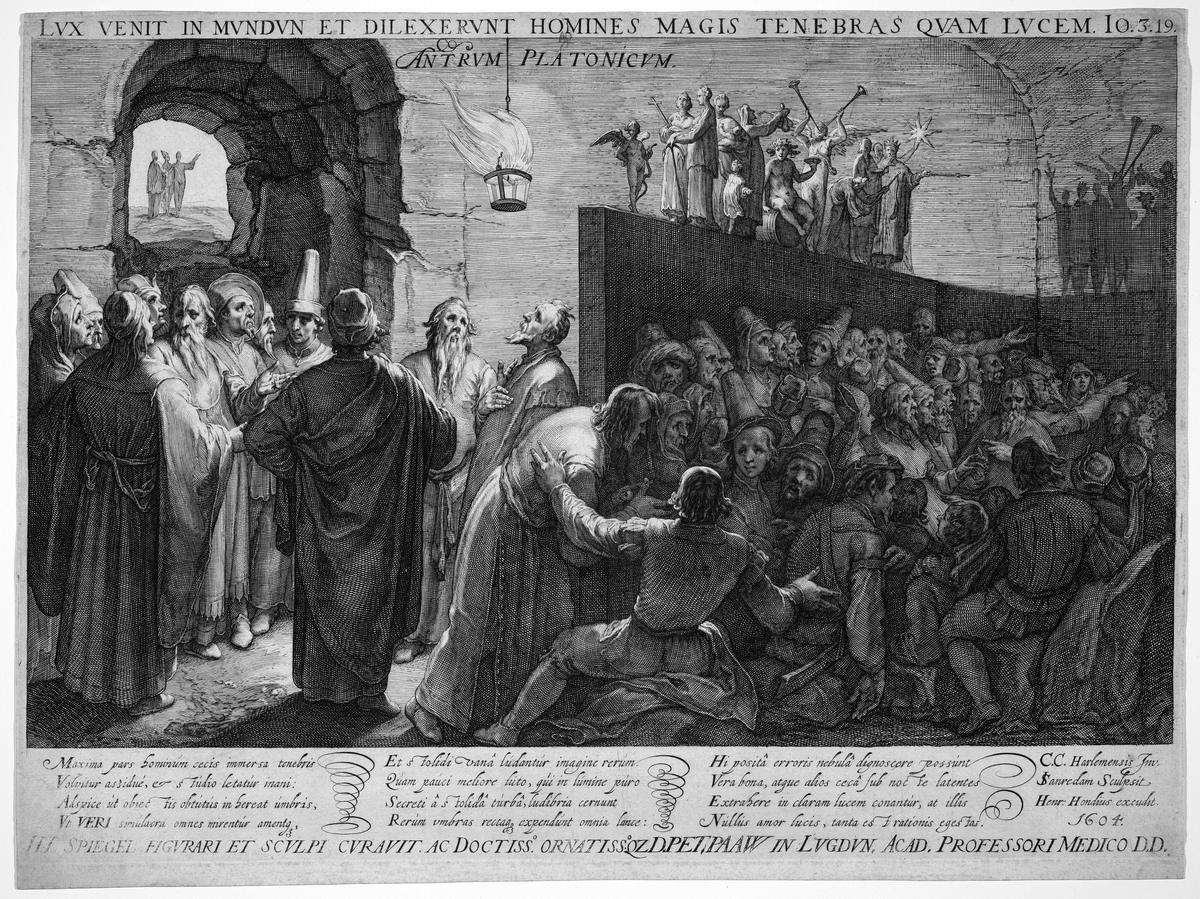
“To them, the truth would be literally nothing but the shadows of the images.”
In plain words: What we take for the world is often only its shadow on the wall.
Plato, Republic, Book VII, 515c, translated by Benjamin Jowett
Brilliant results on a demo account, and then the live account went strangely quiet?
2 · The storyThe prisoners loved their shadows.
In the seventh book of the Republic, Plato asks us to imagine prisoners chained in a cave since childhood, facing a wall. Behind them burns a fire, and between the fire and the prisoners people carry objects back and forth. The prisoners see only the shadows of these objects on the wall.
They give the shadows names. They hold competitions in predicting which shadow will come next, and award honours to the best predictors.Plato, Republic, Book VII, 514a–517a. It is, in other words, a very old leaderboard.
Then one prisoner is freed and turned towards the fire. The light hurts his eyes. The real objects look less real than the shadows he knew. Dragged up into the sunlight, he is blinded at first, and only slowly sees the world as it is.
And when he goes back down to tell the others? They laugh at him, because he is now worse at the shadow game. If they could get their hands on him, Plato adds, they would kill him. Plato had watched what Athens did to his teacher, Socrates. He knew what he was writing about.
3 · The tradeA demo account is a wall of shadows.
Demo trading is Plato’s shadow game, with a ranking table. The chart is real, the prices are real, the setups are real. Only the consequences are shadows. A loss is a number that moves, and numbers do not keep you awake at night.
Then you open a live account and turn towards the fire. The same −4% now has a body: a faster pulse, a tight chest, the urge to do something, anything. You still know the plan. You simply following it. The stop moves “just a little”. The winner is closed early, because a sure gain feels safer than a possible one. The loser is held, because closing it would make the loss real.
None of this appeared in the demo, so the demo could not warn you about it. That is not a flaw in the demo. It is a flaw in treating it as evidence.
4 · The testSame trade. Two worlds.
Skip the testHow it works. Below is one trade. You bought euros, betting they would rise against the dollar. Instead the price has fallen by 4.2%. Same chart, same plan.
Your job. Switch between “Demo” and “Real money”, and compare what happens to you in each: your pulse, your thoughts, your next move.
- Your pulse
- Your thought
- What you do
What it showsOpen it once you have tried the test
Nothing on the chart changes between the two. Only the person in front of it does. A strategy is only as good as the person carrying it out under pressure, and a never puts you under pressure. That is why a demo record says so little about a live one.
The calm you cannot predict the heated you.
Psychologists call this the hot–cold empathy gap. In a calm, “cold” state, people consistently underestimate how much hunger, fear, pain or excitement will change their own behaviour later.Loewenstein, “Hot-cold empathy gaps and medical decision making”, Health Psychology, 2005.
In one study, employees at several companies chose a snack to be delivered a week later. Those who chose while hungry picked unhealthy snacks far more often than those who chose after lunch.Read and van Leeuwen, “Predicting hunger”, Organizational Behavior and Human Decision Processes, 1998. Their stomach at the moment of choosing decided for the person they would be a week later.
Trading runs the same experiment in reverse. Plans are written cold and carried out hot.
6 · The fixPractise in the fire, not in front of the wall.
You cannot avoid the fire. You can get used to the light.
- Go live small, not big. Replace the demo with real money at a size you can lose without panic, but large enough that you still feel it. The aim is to learn your own reactions, not to get rich yet.
- Write the plan cold, read it hot. Write entry, stop and target while you are calm. When the trade moves against you, read the plan out loud before you touch anything.
- Watch your body, not only your chart. When your pulse rises, your decisions change. Notice it, name it, and do nothing for sixty seconds.
Rate your pulse.
For one week, before you touch a live , rate your stress from 1 to 10 and write it next to the trade. Then compare what you did at 3 with what you did at 8.
Tell us what changes when the money is real.
ask@socratrades.com
Carrier pigeons are no longer used. Too many of them followed the flock.
Free. Answered in writing by real people; Socratrades is a character. General answers only: we don’t assess your situation or name instruments. Never published without your yes.A demo account tests a strategy, not the person carrying it out. Plans are made in a calm, “cold” state and carried out in a “hot” one, and people consistently underestimate how emotion will change their behaviour: the hot–cold empathy gap (Loewenstein, 2005). Going live with a small size you still feel teaches what a demo cannot.
Three questions readers ask
Why do I do well on demo and badly with real money?
A demo tests the strategy, not you. With real money, the same loss arrives with a faster pulse, so stops move and winners are closed early.
Is a demo account useful?
For learning the platform and the mechanics, yes. As evidence of how you will behave with real money, it says very little.
What is the hot–cold empathy gap?
The tendency, when calm, to underestimate how much hunger, fear or excitement will change your behaviour later (Loewenstein, 2005).
Painting: Jan Saenredam after Cornelis van Haarlem, Plato’s Cave, 1604. National Gallery of Art, Washington. Public domain.