DialoguesIV · Aristotle
How many winning trades prove you’re good?
Small samples and survivorship bias
“One swallow does not make a summer, nor does one day.”
In plain words: One good day does not make a good life, and one good trade does not make a good trader.
Aristotle, Nicomachean Ethics, Book I, 1098a, translated by W. D. Ross
Ever trusted someone because of one great year? Or yourself, because of one great month?
2 · The storyA whole life, not one lucky day.
Aristotle would have hated your trading app. It only shows you today.
He spent much of his life on one question: what makes a life go well? His answer, in the Nicomachean Ethics: not a feeling but a way of living, and it can only be judged over its whole length. One happy day proves nothing, just as one swallow does not bring the spring.
He treated evidence the same way. Before writing about politics, he and his students collected the constitutions of 158 Greek city-states. Before writing about animals, he described hundreds of species. One vivid example impressed him about as much as one good month should impress you.
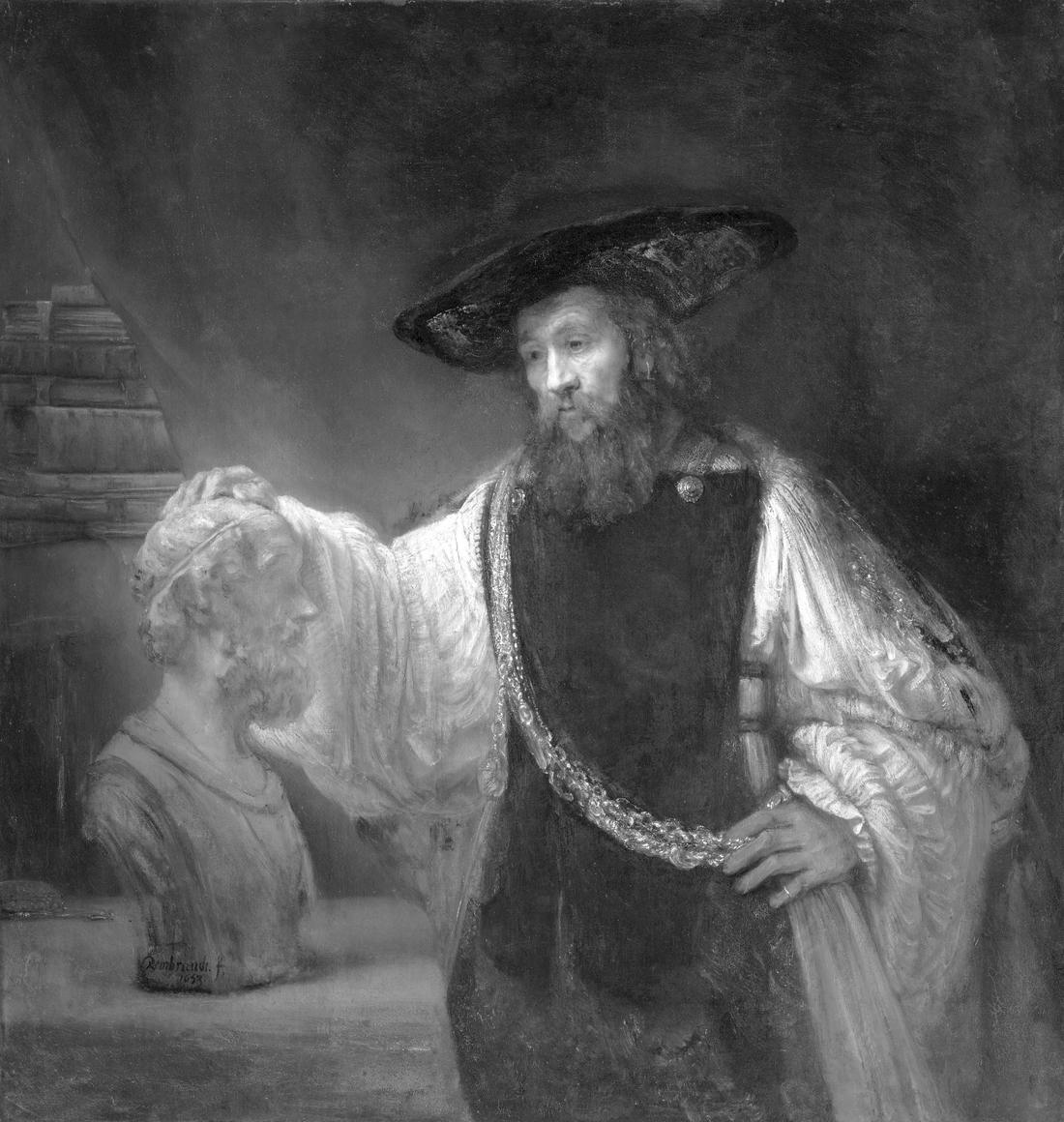
Rembrandt painted him with his hand on a bust of Homer, the poet whose reputation had lasted two thousand years. Not one good evening of storytelling. A track record.
3 · The tradeOne winning year does not make a trader.
A trading record is a sample, and a short record is a tiny sample. Tiny samples are mostly noise. Yet we read them as proof. A friend triples his account in a year, and suddenly he understands markets. A stranger posts a screenshot of one winning trade, and suddenly he is worth following.
It gets worse, because of who gets seen. Thousands of people try. The ones who fail close their accounts quietly. The ones who win by chance write threads, give interviews and sell courses. You do not meet a random sample of traders. You meet the survivors, and survivors always look skilled.
The same applies to your own record. Three good months feel like evidence. They are a swallow.
4 · The testWatch a thousand traders become a genius.
Skip the testHow it works. 1,024 traders, none of them with any skill. Each year, half of them beat the market by pure chance, like a coin toss. Press Next year ten times and watch how many still have a perfect record.
What it showsOpen it once you have tried the test
After ten years, one trader has beaten the market ten years in a row, without any skill. Ten out of ten looks like genius. It is simply what chance produces when enough people play. Start with 100,000 traders and you get about a hundred such “geniuses”, each with a story about why it worked.
We expect small samples to look like the long run.
In a classic paper, Amos Tversky and Daniel Kahneman showed that even trained research psychologists expected small samples to resemble the whole far more closely than chance allows. They called it the belief in the law of small numbers.Tversky and Kahneman, “Belief in the law of small numbers”, Psychological Bulletin, 1971.
Survivorship makes it worse. When investment funds close, they tend to disappear from the databases, so the funds that remain look better than the average fund really was. One study estimated the distortion at almost one percentage point a year.Elton, Gruber and Blake, “Survivorship bias and mutual fund performance”, Review of Financial Studies, 1996. The swallows are counted. The ones that did not make it are not.
6 · The fixJudge the summer, not the swallow.
Aristotle would have asked for more cases. So should you.
- Count your trades, not your wins. Thirty trades say very little about a strategy. A few hundred begin to say something. Until then, treat your results as a weather report, not a climate.
- Ask how many tried. Before you admire a record, ask how many people tried the same thing, and where they are now.
- Grade the process, not the result. A good trade can lose and a bad trade can win. Score each trade on whether you followed your rules, not on the money it made.
Count before you judge.
Count the trades you have closed with your current strategy. Write that number above your results, and do not call the strategy good or bad until it reaches a few hundred.
Ask how much your record really proves.
ask@socratrades.com
We retired the carrier pigeons. One kept flying back to its .
Free. Answered in writing by real people; Socratrades is a character. General answers only: we don’t assess your situation or name instruments. Never published without your yes.A short winning record is a small sample, and small samples are mostly noise. Tversky and Kahneman (1971) showed that even research psychologists expect small samples to resemble the long run. Survivorship makes it worse: Elton, Gruber and Blake (1996) estimated that dropping closed funds flatters reported fund returns by almost one percentage point a year.
Three questions readers ask
How many trades do I need to know whether a strategy works?
There is no magic number. Thirty trades say very little; a few hundred begin to say something.
What is survivorship bias in investing?
Judging by the traders and funds still visible while the failures have disappeared. Elton, Gruber and Blake estimated that it flatters reported fund returns by almost one percentage point a year.
Can someone beat the market ten years running by pure luck?
Yes. Among 1,024 traders with no skill and a coin-toss chance each year, about one ends with a perfect ten-year record.
Painting: Rembrandt, Aristotle with a Bust of Homer, 1653. The Metropolitan Museum of Art. Public domain.