“If I beg and pray you to set me free, then bind me more tightly still.”
In plain words: Sometimes the wisest thing you can do is tie your own hands in advance.
Homer, Odyssey, Book XII, translated by Samuel Butler
Have you ever broken a trading rule you swore you would never break again?
2 · The storyUlysses did not trust his willpower. He trusted a rope.
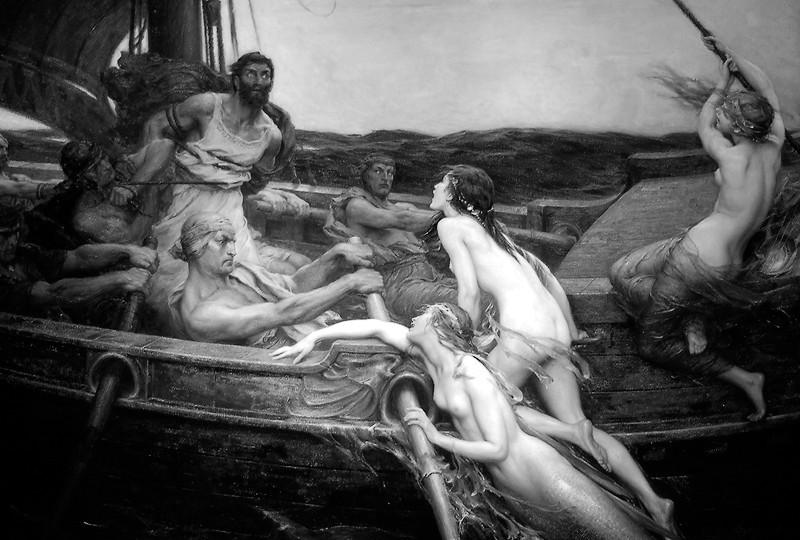
In Homer’s Odyssey, Ulysses must sail past the Sirens, whose song is so beautiful that sailors steer towards it and die on the rocks. Ulysses wants to hear the song and survive.
So he makes his plan while the sea is calm. He fills his crew’s ears with beeswax. He orders them to tie him to the mast, and adds one crucial instruction: if I beg you to set me free, tie me tighter. When the song begins, he begs. They tie him tighter. The ship sails on.
The Norwegian philosopher Jon Elster made Ulysses the model of precommitment: rational people sometimes bind themselves in advance, because they know their future self will want something different, and will be very persuasive about it.
3 · The tradeEvery Siren sounds reasonable.
The Sirens of trading do not sound like madness. They sound like good arguments. Move the a little, it is only noise. Add to the loser, it is cheaper now. One more trade to make back today’s losses. This time is different.
Each of these thoughts is persuasive in the moment, and that is exactly the problem. The moment is when you are least able to judge it: the pulse is up, the loss is real, the screen is red. Ulysses’ insight was not that he would be weak. It was that he would sound strong, and be wrong.
The answer is not more willpower. It is fewer decisions made in the moment.
4 · The testWrite your pact.
Skip the testHow it works. Choose your maximum risk per trade and the point at which you stop for the day, add one thing you will never do, sign with your finger or mouse, and seal it. Save the image and use it as your phone’s lock screen. Nothing you write here leaves your device.
What it showsOpen it once you have tried the test
A rule written while calm is a rope. It only works if it still holds when you beg it not to.
Binding yourself works. Partly.
Dan Ariely and Klaus Wertenbroch paid volunteers to proofread three long texts. Some had one final deadline, some had three evenly spaced deadlines set for them, and some could set their own binding deadlines. Those who set their own found more errors than the final-deadline group, but fewer than the group whose deadlines were set for them.Ariely and Wertenbroch, “Procrastination, deadlines, and performance”, Psychological Science, 2002. Tying yourself helps. Being tied by something that does not negotiate helps more.
Richard Thaler and Shlomo Benartzi asked employees to commit, in advance, to saving part of their future pay rises. Savings rates rose from 3.5% to 13.6% in under four years.Thaler and Benartzi, “Save More Tomorrow”, Journal of Political Economy, 2004. The decision was made once, while calm, and then simply carried out.
6 · The fixA pact you keep is discipline. A pact that keeps itself is a system.
Twelve dialogues, twelve mistakes, one common cure: decide before the moment, not in it.
- Write three rules while calm. Risk per trade, a daily stop, one thing you never do. Keep them short enough to remember under stress.
- Make breaking them inconvenient. Tell someone your rules, or set your ’s risk limits wherever your platform allows it.
- Remove the moment. The fewer decisions you make during a trade, the fewer Sirens you hear.
Make the pact your lock screen.
Seal your pact above, save it, and use it as your phone’s lock screen for thirty days. Each time you are tempted to break a rule, write down the Siren’s exact words.
Send us your rules, in your own words. You get a written reply: which rules are clear, which are vague, and which a bad day will break. We don’t tell you what to buy or sell.
ask@socratrades.com
Carrier pigeons are no longer used. Too many of them followed the flock.
Free. Answered in writing by real people; Socratrades is a character. General answers only: we don’t assess your situation or name instruments. Never published without your yes.Precommitment means binding yourself in advance, because your future self will argue persuasively for breaking the rule, as Ulysses did with the Sirens. The evidence says it works partly: in one study, self-set deadlines beat a single final deadline, though deadlines set by others worked better (Ariely and Wertenbroch, 2002). Write your trading rules while calm.
Three questions readers ask
What is precommitment?
Binding yourself in advance because you expect your future self to want something else. Jon Elster used Ulysses and the Sirens as the model.
Why do I break my own trading rules?
The arguments for breaking them arrive when you are least able to judge them: pulse up, loss real, screen red.
Does writing down trading rules help?
Partly. Self-set deadlines beat a single final deadline, but deadlines set by others did better (Ariely and Wertenbroch, 2002). Committing in advance raised savings rates from 3.5% to 13.6% (Thaler and Benartzi, 2004).
Painting: Herbert James Draper, Ulysses and the Sirens, 1909. Ferens Art Gallery, Hull. Public domain.