“We suffer more often in imagination than in reality.”
In plain words: Most of what we fear never happens, but we suffer it anyway, in advance.
Seneca, Letters to Lucilius, 13, translated by Richard M. Gummere
Have you checked your portfolio today? More than once? This one is about that.
2 · The storyThe richest Stoic in Rome.
Seneca wrote some of history’s finest advice on not caring about money. He was also one of the richest men in Rome. His critics noticed.
He was a Stoic philosopher, a playwright, and tutor and later adviser to the emperor Nero. He knew money, and he knew fear: he lived next to an emperor whose moods could end careers, and lives.
In his letters to his younger friend Lucilius he came back to one idea again and again. We are frightened far more often than we are ever harmed. “There are more things, Lucilius, likely to frighten us than there are to crush us.” We suffer from rumours, from imagined futures, from disasters that never arrive.
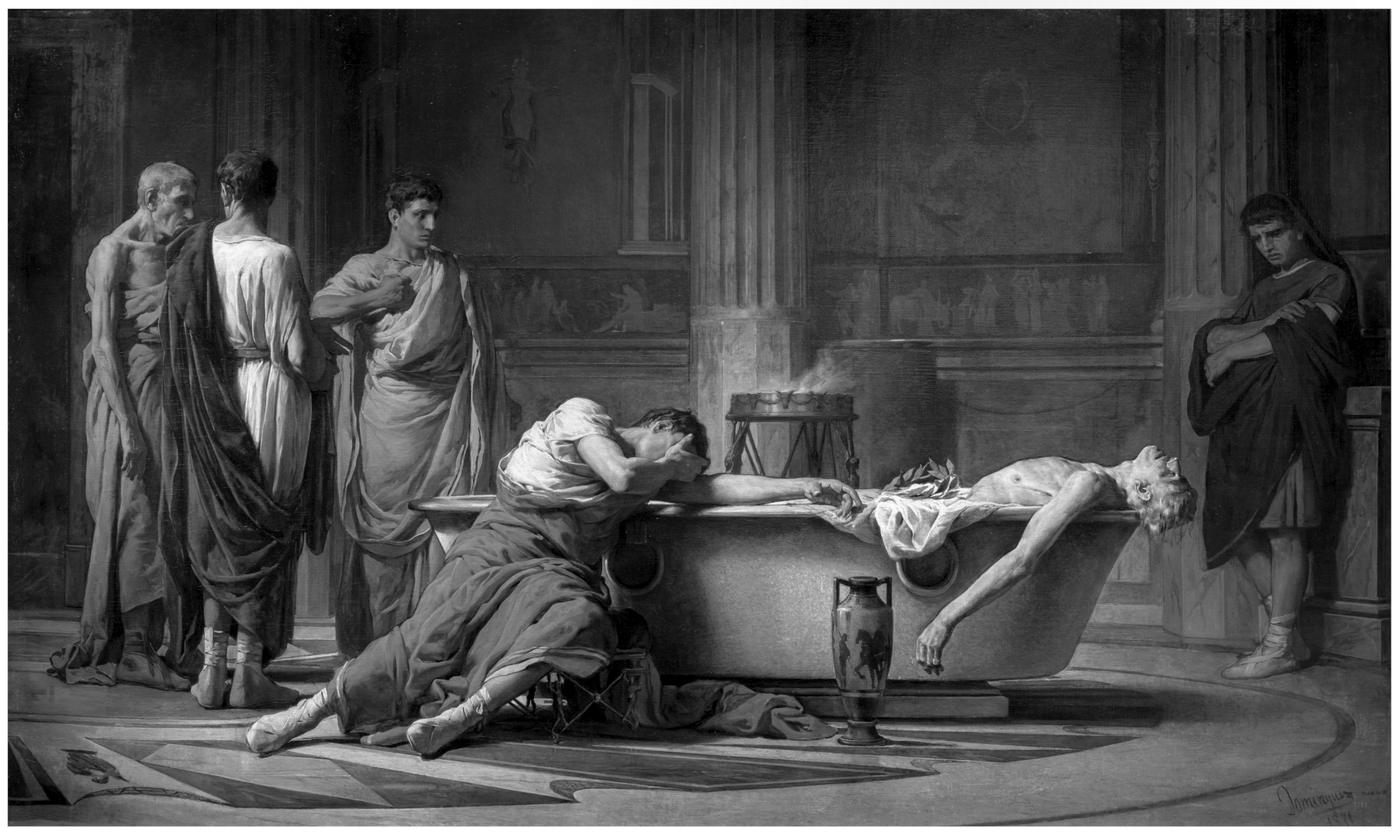
He lived by it to the end. In AD 65 Nero ordered him to take his own life. According to the historian Tacitus, he did so calmly, still dictating to his secretaries.Tacitus, Annals, Book XV, 62–64.
3 · The tradeThe rumour now lives in your pocket.
Seneca’s rumours arrived by messenger, perhaps once a week. Your arrives every second, by push notification.
Each look is a small event. Up: a little pleasure. Down: a little pain. And because, in many studies, losses hurt roughly twice as much as equal gains please, the pains add up faster than the pleasures, even when the investment is doing exactly what it should.
So the investor who checks every hour lives a different life from the investor who checks once a year, with exactly the same money. One sees a constant stream of small losses and feels poor. The other sees a gain about two looks in three, and the pain and the pleasure roughly cancel out. Guess which of the two sells at the bottom.
4 · The testChoose how often you look.
Skip the testHow it works. One hypothetical investment, held for five years. Choose how often you check it. The numbers show how often a single look shows a loss, how many times you look in five years, and how many of those looks are red. The bar shows how it feels, counting each loss as twice as painful as an equal gain is pleasant.
How it feels
Hypothetical investment returning 7% a year on average, with swings typical of a share index. Not a forecast.
What it showsOpen it once you have tried the test
Checked every day, almost every second look is red, and five years feel like constant pain. Checked once a year, two looks in three are green, and pain and pleasure roughly cancel out. Checked every five years, it mostly feels calm. The money is identical. Only the frequency of looking has changed.
The more often you look, the less you dare.
The economists Shlomo Benartzi and Richard Thaler called this myopic loss aversion. Investors who evaluate their portfolios often see more losses, feel more pain and tend to take less risk than their own long-term goals require.Benartzi and Thaler, “Myopic Loss Aversion and the Equity Premium Puzzle”, Quarterly Journal of Economics, 1995.
Uri Gneezy and Jan Potters then tested it in the laboratory. Participants who received feedback after every round invested less in a favourable bet, and ended up earning less, than participants who saw the same results less often.Gneezy and Potters, “An experiment on risk taking and evaluation periods”, Quarterly Journal of Economics, 1997. The information was the same. The frequency made them poorer.
6 · The fixDecide when to look. Then let the screen be.
Seneca did not tell Lucilius to caring. He told him to stop rehearsing.
- Set a looking schedule. Decide how often your strategy actually needs you: daily, weekly or monthly. Look then, and not in between.
- Switch off the price alerts. Keep alerts only for the levels at which you would actually act. Every other notification is a rumour.
- Decide what would make you act. Before you open the app, write down what you would need to see to change anything. If you do not see it, close the app again.
Count your looks.
For three days, make a tally mark every time you open your trading app. On day four, choose a looking schedule that cuts the count in half, and keep it for a week.
Tell us how often you look, and what it does to you.
ask@socratrades.com
No more carrier pigeons. The last one panicked at the first red candle and sold the letter at a loss.
Free. Answered in writing by real people; Socratrades is a character. General answers only: we don’t assess your situation or name instruments. Never published without your yes.Myopic loss aversion means that the more often investors check, the more losses they see, and the less risk they take. Benartzi and Thaler named it in 1995. Gneezy and Potters (1997) showed in the laboratory that frequent feedback led people to invest less in a favourable bet, and to earn less. The fix: decide in advance how often to look.
Three questions readers ask
How often should I check my portfolio?
socratrades prescribes no number. Decide in advance how often your strategy actually needs you, and look only then.
What is myopic loss aversion?
Feeling losses more strongly than equal gains, roughly twice as strongly in many studies, combined with checking results too often (Benartzi and Thaler, 1995).
Does checking every day make you a worse investor?
In Gneezy and Potters’ experiment, people given frequent feedback invested less in a favourable bet and earned less than those who saw the same results less often.
Painting: Manuel Domínguez Sánchez, The Suicide of Seneca, 1871. Museo del Prado, Madrid. Public domain.