DialoguesX · Nietzsche
Why does a trade feel safer when everyone is in it?
Herding and fear of missing out
“Insanity in individuals is something rare — but in groups, parties, nations and epochs it is the rule.”
In plain words: Alone, people are mostly sensible. In crowds, they can believe almost anything.
Friedrich Nietzsche, Beyond Good and Evil, §156, translated by Helen Zimmern
Ever bought something mainly because everyone else seemed to be buying it?
2 · The storyThe philosopher who distrusted the herd.
Friedrich Nietzsche became a professor at twenty-four, gave up his chair ten years later because of ill health, and spent the following decade writing books that almost nobody bought. He would have made a poor fund manager and an excellent risk officer.
His great target was the herd: our deep wish to think what everyone else thinks, and to call it truth. Individuals, he wrote, rarely go mad. Groups, parties, nations and whole eras do it as a matter of routine.
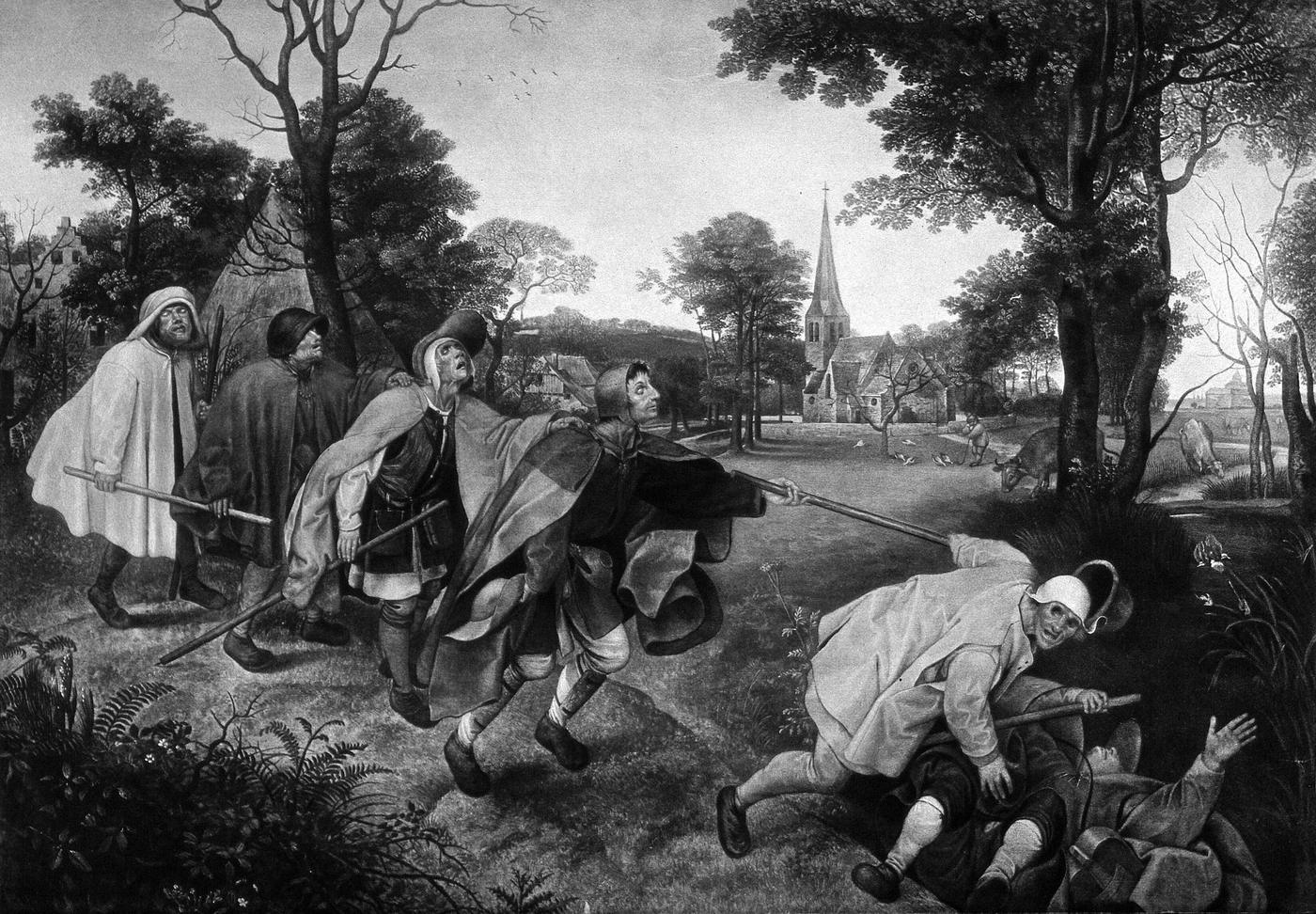
Three centuries earlier, Pieter Bruegel had painted the same idea: a line of blind men, each holding on to the one in front, following their leader into the ditch. The striking thing is that each man behaves sensibly. He follows the person ahead, who seems to know the way.
3 · The tradeA trade does not get safer because it gets crowded.
In markets the crowd always answers first. Before you have finished thinking, you have already seen it: the chat, the comments, the headline, the price itself. A rising price feels like proof, because so many people seem to agree with it.
That is the trap. When something rises because everyone is buying it, the crowd is not information about the asset. It is information about the crowd. And when everyone you know is already in, one simple question becomes urgent: who is left to buy?
Fear of missing out is the herd in its modern form. It does not feel like following. It feels like finally understanding what everyone else seems to have understood.
4 · The testWhich line matches?
Skip the testHow it works. Three rounds. In each, pick the line that is the same length as the reference line. Before you answer, five other traders give theirs. Take your time: the right answer is always clearly visible.
What it showsOpen it once you have tried the test
In rounds two and three, the five traders were wrong on purpose. If you hesitated, even for a second, you felt the pull that Asch measured. In a market, the wrong answer is rarely this obvious, and the crowd is a great deal larger.
Three in four went along at least once.
In the 1950s the psychologist Solomon Asch ran this test with real people in a real room. The other participants were actors, told to give the same wrong answer. Three in four of the genuine participants went along with the obviously wrong majority at least once, and about one answer in three followed the group.Asch, “Effects of group pressure upon the modification and distortion of judgments”, 1951.
Later replications usually found less conformity than Asch did, and the amount varies between countries and decades. It has rarely disappeared.Bond and Smith, “Culture and conformity”, Psychological Bulletin, 1996.
But Asch also found the cure. When just one other person in the room gave the correct answer, conformity dropped sharply. One ally was enough to break the spell of the crowd.
6 · The fixFind your one dissenter.
You do not need to fight the herd. You only need to it answering for you.
- Decide before you read. Form your view and write it down before you open the chat, the forum or the news.
- Keep one dissenter. A single ally breaks the pull of the crowd. Find one sober voice who often disagrees with the market’s mood, and read them first.
- Ask who is left. When everyone you know already owns something, ask who is still going to buy it, and what happens if they do not.
Decide before you read.
For one week, write down your view on a trade before you open a chat, a forum or a news app. Afterwards, note how often reading changed your mind, and in which direction.
Tell us about the trade everyone around you is in.
ask@socratrades.com
We retired the carrier pigeons. One kept flying back to its .
Free. Answered in writing by real people; Socratrades is a character. General answers only: we don’t assess your situation or name instruments. Never published without your yes.Herding is buying because others are buying, and fear of missing out is its modern form. In Asch’s original conformity experiments, three in four participants went along with an obviously wrong majority at least once, and about one answer in three followed the group. A single dissenter reduced conformity sharply. A crowded trade is information about the crowd, not the asset.
Three questions readers ask
What is herding in trading?
Buying or selling because others are, and treating the crowd’s agreement as evidence about the asset.
How do I stop FOMO trading?
Write your view down before opening the chat or the news, read one sober dissenter first, and ask who is left to buy.
What did Asch’s conformity experiment show?
In his original experiments, three in four participants went along with an obviously wrong majority at least once. One ally reduced conformity sharply. Later replications found less conformity.
Painting: After Pieter Bruegel the Elder, The Blind Leading the Blind (1568), photomechanical reproduction. Wellcome Collection. Public domain.