“It must be possible for an empirical scientific system to be refuted by experience.”
In plain words: An idea only counts if it says in advance what would prove it wrong.
Karl Popper, The Logic of Scientific Discovery, §6
Is there a position in your account that you are holding “until it comes back”?
2 · The storyA thousand white swans prove nothing.
A thousand white swans. Then one black one, and the thousand were worth nothing.
For centuries Europeans had seen only white swans, and every new one confirmed the old belief: all swans are white. Then, in 1697, Dutch sailors under Willem de Vlamingh reached the coast of Western Australia and saw black ones.
The Viennese philosopher Karl Popper built a whole theory of science on that imbalance. You can never prove a general claim by collecting examples that agree with it. You can only test it by looking for the example that would break it. A theory that no observation could ever refute, Popper said, is not science. It is a belief wearing a lab coat.
His targets were grand theories that could explain any result at all. A theory that explains everything explains nothing. Traders know the type: the market commentator for whom every move confirms his view. Up? As predicted. Down? Also as predicted, if you read him properly.
3 · The tradeA trade without a stop is not a thesis. It is a hope.
Every trade is a small theory: this will go up, for these reasons. Popper would ask one question before you enter: what would prove you wrong?
Most traders cannot answer, because they never asked. So when the price falls, there is no refutation, only reinterpretation. It is a buying opportunity. It is a shakeout. The fundamentals have not changed. The loss grows, and the theory grows more flexible to fit it.
Meanwhile the winners are sold quickly. Selling a winner feels like being proved right. Selling a loser feels like a verdict on you. So the winners leave, the losers stay, and the slowly fills up with your mistakes.
4 · The testOne of them has to go.
Skip the testHow it works. One quick question about two positions. Answer the way you would with your own money, without overthinking it.
You need cash and must sell one of two positions. You bought both at 100. Which do you sell?
What it showsOpen it once you have tried the test
Most people sell the winner. It feels like taking a profit and avoiding a loss. But the price you paid tells you nothing about the future. The only question that matters is which of the two ideas still holds.
The winners they sold kept winning.
Terrance Odean studied 10,000 brokerage accounts. Investors sold their winning positions about one and a half times as readily as their losing ones. And the winners they sold went on to beat the losers they kept by about 3.4 over the following year.Odean, “Are Investors Reluctant to Realize Their Losses?”, Journal of Finance, 1998.
The pattern has a name, the disposition effect, and it is one of the most consistently measured mistakes in finance.Shefrin and Statman, “The disposition to sell winners too early and ride losers too long”, Journal of Finance, 1985. It is not a lack of knowledge. It is the wish not to be wrong, wearing the costume of patience.
6 · The fixName your black swan before you enter.
Popper’s method fits on the back of an order ticket.
- Write the refutation first. Before every trade, write the price, the event or the date at which you will admit the idea was wrong. If you cannot name one, do not take the trade.
- Ask the fresh-money question. Once a month, for every : if I did not own this today, would I buy it at this price? If not, the price you paid is the only thing keeping it.
- Sell ideas, not feelings. Close a position because its idea has been refuted, not because it is red or green.
Name the black swan.
For every open position, write the price, event or date that would prove the idea wrong. Any position without one gets the fresh-money question: would I buy it today, at this price?
Send us your position and what would prove it wrong.
ask@socratrades.com
Carrier pigeons are no longer used. Too many of them followed the flock.
Free. Answered in writing by real people; Socratrades is a character. General answers only: we don’t assess your situation or name instruments. Never published without your yes.The disposition effect is the tendency to sell winners too early and hold losers too long. Odean (1998) studied 10,000 brokerage accounts. Investors sold winners about 1.5 times as readily as losers, and the winners they sold beat the losers they kept by 3.4 percentage points the next year. A stop-loss set in advance names what would prove you wrong.
Three questions readers ask
What is the disposition effect?
The tendency to sell investments that have risen too early and hold those that have fallen too long. Shefrin and Statman named it in 1985.
Why do traders sell winners too early and hold losers?
Selling a winner feels like being proved right; selling a loser feels like a verdict on you. In Odean’s study, the winners investors sold beat the losers they kept by about 3.4 percentage points over the next year.
What does Karl Popper have to do with a stop-loss?
Popper argued that an idea only counts if it says in advance what would prove it wrong. A stop-loss set before entry writes that down.
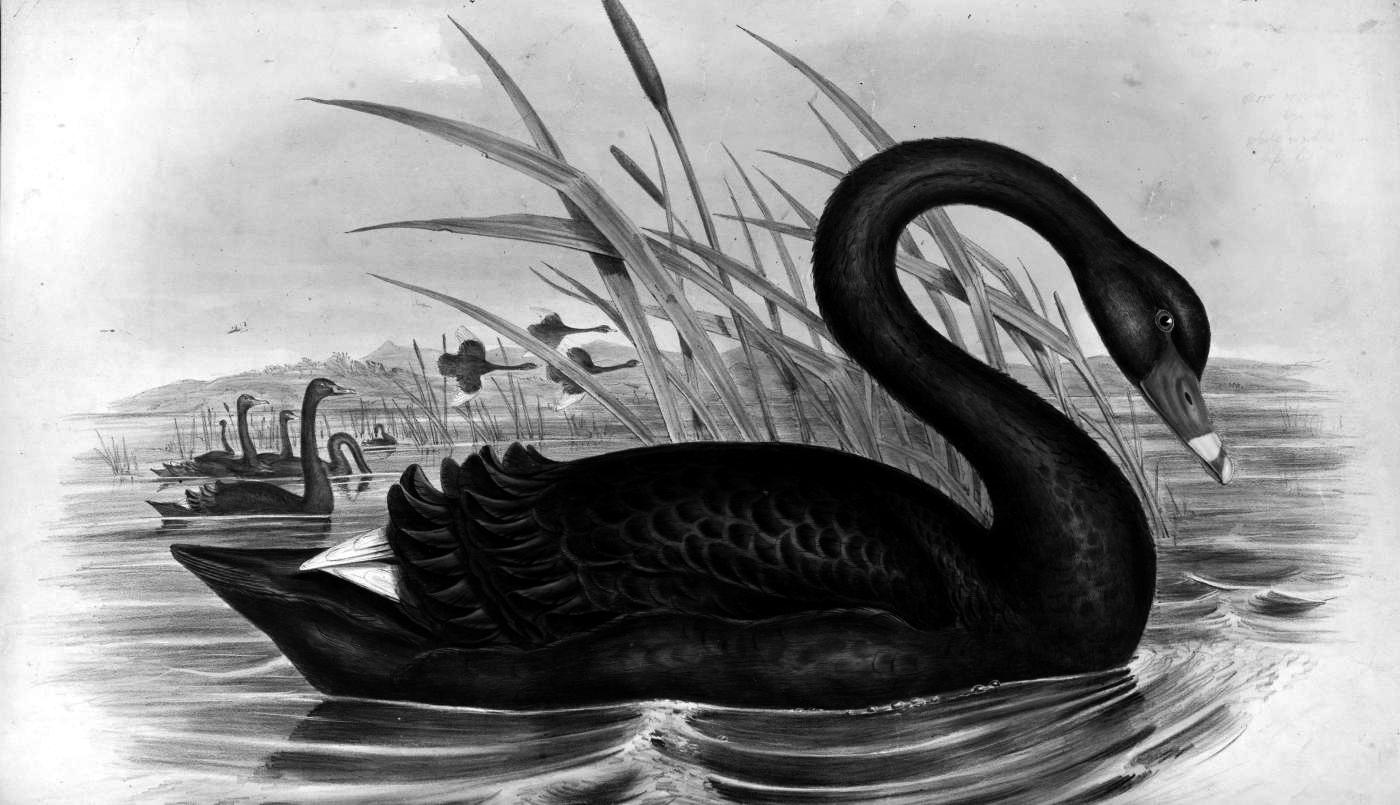
Painting: John Gould, Black Swan, from The Birds of Australia, 1848. State Library of New South Wales, CC BY 4.0.